Plan your trip to Innsbruck
- How long
- 2 days for the city and the Nordkette; add days for skiing, the Stubai Glacier or a lake day at Achensee.
- Best for
- People who want Alpine scenery and a real city in one trip: hikers, skiers, Habsburg-history fans, and train travellers (Munich, Salzburg and Verona are direct).
- Skip it if
- You don't care for mountains: the Old Town is small and seen in half a day.
If you only do three things
- Ride the Nordkette cable cars from the city centre to Hafelekar station (2,256 m) for the view over the Inn Valley.
- The Old Town: the Golden Roof, the Stadtturm (133 steps up) and the Hofkirche with its 28 bronze statues.
- Ambras Castle and its Renaissance Spanish Hall, or Zaha Hadid's Bergisel ski jump.
A one-day route
- Morning: Golden Roof and Herzog-Friedrich-Strasse, climb the Stadtturm, then the cathedral and Hofkirche.
- Midday: Lunch in the Old Town, then walk down Maria-Theresien-Strasse to the Annasäule for the mountain view.
- Afternoon: Nordkette cable cars from Congress station to Seegrube and Hafelekar (check the last ride down).
- Evening: Dinner in a Tyrolean Gasthof: try Gröstl or Käsespätzle.
Before you go
- Innsbruck Card (2026): €69 for 24h, €79 for 48h, €89 for 72h; it includes public transport, the Nordkette cable cars and the main museums.
- Without the card: a single IVB ticket is €3.30 and a 24-hour ticket €7.30.
- The Achenseebahn steam railway runs from May to 24 October 2026, with no winter service.
- Christmas markets run from 13 November 2026 (some until 6 January 2027); the Bergisel ski jump hosts a Four Hills Tournament event in early January.
Prices, opening status and transport in this plan checked against official sources on 30 September 2026.
Things to do in Innsbruck
Innsbruck's skyline blends medieval towers with Baroque palaces and bold modern architecture, all framed by the dramatic Nordkette mountain range. From the glittering Goldenes Dachl to the sleek curves of the Bergisel Ski Jump, the city's landmarks tell a story spanning six centuries of Alpine history.
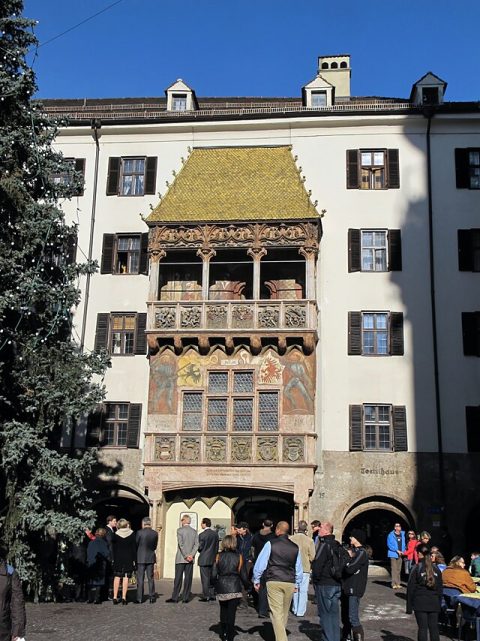
Goldenes Dachl (Golden Roof)
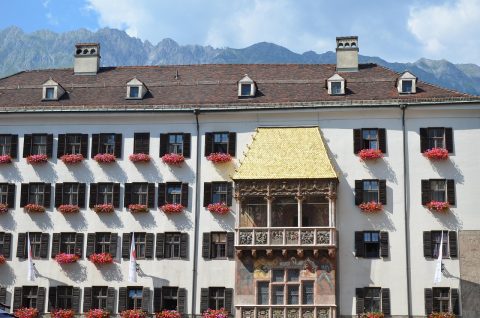
Innsbruck's most iconic symbol, the Goldenes Dachl is a late-Gothic oriel window crowned by a roof of 2,657 fire-gilded copper tiles. Commissioned by Emperor Maximilian I around 1500 as a royal box for watching tournaments, it is decorated with reliefs depicting the emperor, his two wives, and court jesters. A small museum inside explores Maximilian's life and reign. The shimmering rooftop is best photographed in early morning light before the crowds arrive.
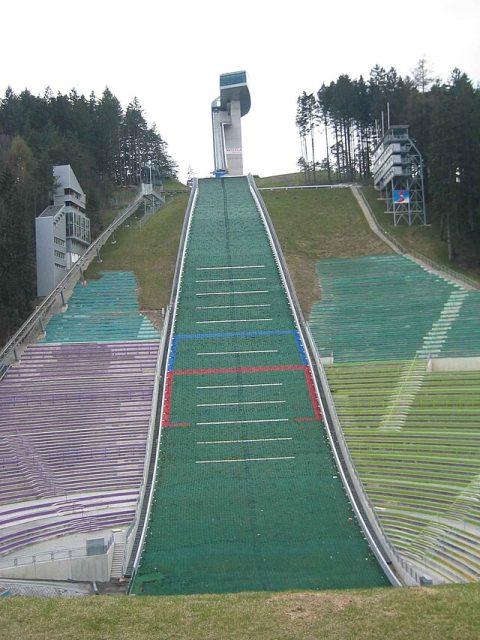
Bergisel Ski Jump
Designed by Zaha Hadid and opened in 2002, the Bergisel Ski Jump is a striking piece of contemporary architecture perched high above Innsbruck. The venue hosted the 1964 and 1976 Winter Olympics and remains an active FIS World Cup site. Visitors can ride the funicular and elevator to the tower's panoramic café, offering breathtaking views over the Inn Valley and surrounding Alps. An exhilarating experience even without a competition.
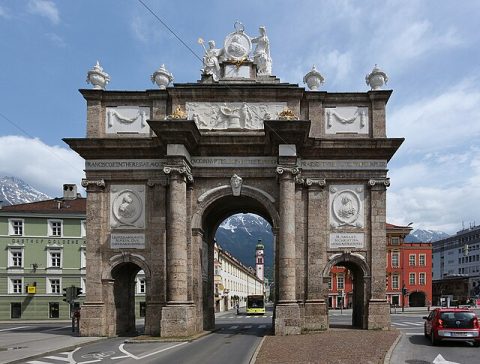
Triumphpforte (Triumphal Arch)
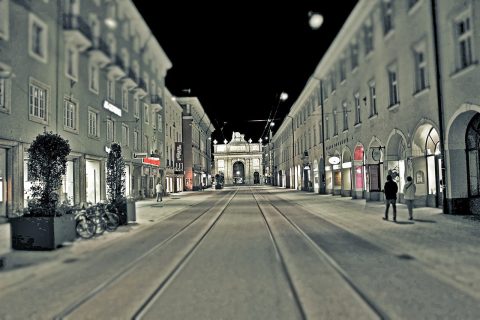
Standing at the southern end of Maria Theresien Strasse, the Triumphpforte was erected in 1765 to simultaneously celebrate the marriage of the future Emperor Leopold II and mourn the death of Emperor Franz I Stephan. Uniquely, the arch has two faces: the south side celebrates the royal wedding while the north bears mourning symbols. One of the finest examples of Baroque monumental architecture in the Alpine region, it frames a classic mountain view.
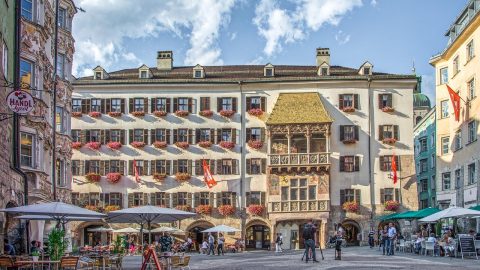
Stadtturm (City Tower)
The Stadtturm rises 51 metres above the Old Town, built around 1450 as part of the original city hall and serving as a watchtower and fire lookout. Visitors who climb the 133 steps to the viewing gallery at 31 metres are rewarded with sweeping panoramic views over Innsbruck's red-tiled rooftops, the Inn River, and the surrounding Alpine peaks. The tower's distinctive octagonal lantern is a defining feature of the Innsbruck skyline, especially beautiful when floodlit at night.
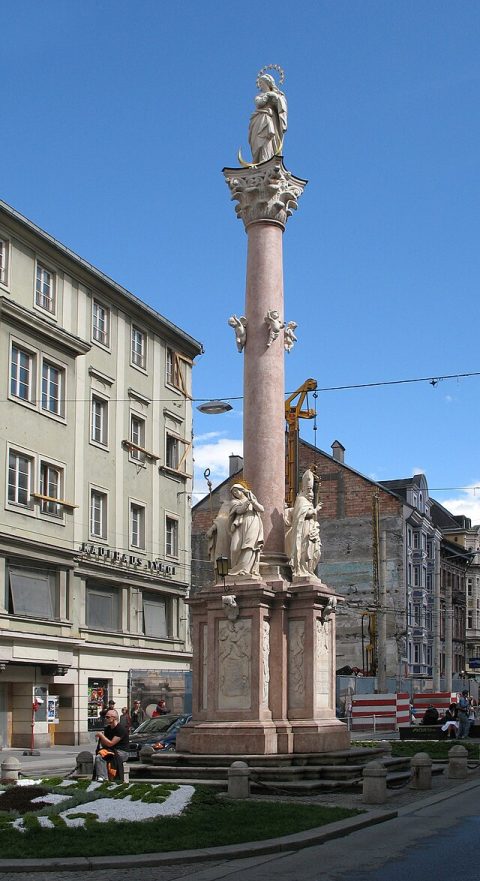
Annasäule (St. Anne's Column)
Erected in 1706 to commemorate the withdrawal of Bavarian troops from Tyrol on St. Anne's Day, the Annasäule is the central landmark of Maria Theresien Strasse. The red marble column is topped by a golden statue of the Virgin Mary, surrounded by four saints — Anne, Cassian, Vigilius, and George — at its base. It serves as the heart of outdoor civic life, a gathering point for locals, and provides the classic backdrop of an Alpine boulevard with mountain views beyond.
Tips for Landmarks & Monuments
- Visit the Goldenes Dachl early morning (before 9 am) to avoid crowds and capture the best light on the gilded tiles.
- Combine the Stadtturm climb with a stroll through the Altstadt — the two are steps apart.
- The Bergisel tower café is open to non-athletes; enjoy coffee with an Alpine panorama.
- The Triumphpforte is always free to view from outside and looks spectacular floodlit after dark.
Innsbruck punches well above its size in museum culture. The Tiroler Landesmuseen network spans art, archaeology, and folk traditions, while imperial collections at the Hofburg and Ambras Castle reflect the city's deep Habsburg heritage across centuries of Alpine rule.
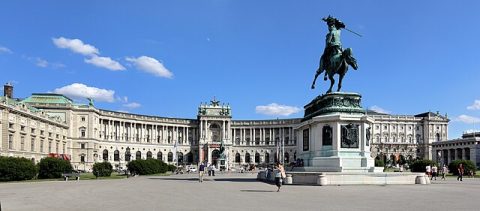
Hofburg Imperial Palace
The Hofburg is Innsbruck's grandest building — a Baroque imperial palace rebuilt under Empress Maria Theresa in the 18th century. The interiors are opulent: the Giants' Hall with its trompe-l'œil ceiling frescoes, state apartments hung with Habsburg portraits, and lavishly appointed ceremonial rooms. The chapel and private chambers give a vivid sense of Habsburg court life. An audio guide is included in the admission price and available in multiple languages.
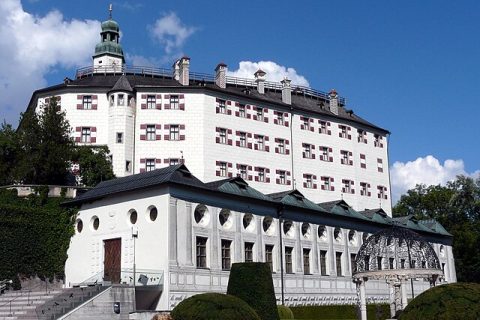
Schloss Ambras (Ambras Castle)
Perched on a forested hill above Innsbruck, Ambras Castle is one of the most significant Renaissance castles in Austria. Transformed by Archduke Ferdinand II in the 16th century, it houses an extraordinary Cabinet of Curiosities, a peerless portrait gallery of European royalty, and an unmatched armour collection. The Spanish Hall — a Renaissance masterpiece painted with portraits of Tyrolean rulers — is among the finest secular interiors in Austria. The surrounding park is free to enter.
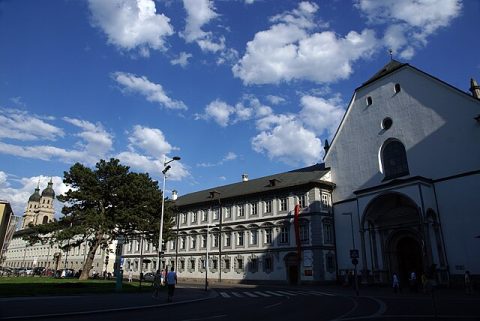
Tiroler Volkskunstmuseum (Tyrolean Folk Art Museum)
Housed in a former Augustinian monastery adjacent to the Hofkirche, the Volkskunstmuseum holds one of the finest collections of Alpine folk art in the world. Highlights include elaborately carved wooden room interiors transplanted from Tyrolean farmhouses, traditional costumes, Nativity scenes, carnival masks, and intricately painted furniture. The museum vividly illustrates rural Tyrolean life across several centuries and is a natural complement to a visit to the Hofkirche next door.
Alpenzoo Innsbruck (Alpine Zoo)
The Alpenzoo is the highest-altitude zoo in Europe, situated at 750 metres on the Weiherburg slope. It specialises exclusively in Alpine wildlife: brown bears, wolves, lynx, golden eagles, Alpine ibex, otters, and bearded vultures. The zoo also serves as a research and conservation centre for endangered Alpine species. The funicular ride up and the mountain scenery add to the experience. Children love the otter feeding sessions and the spacious outdoor enclosures.
Tiroler Landesmuseum Ferdinandeum
Closed for a full renovation and extension, Closed for renovation; reopening is planned for 2028. The Ferdinandeum is Tyrol's premier regional museum, tracing history, art, and culture from prehistoric times to the modern era. Its fine art collection includes important Gothic altarpieces, Baroque paintings, and 19th–20th century Austrian works. The archaeology section covers Roman Innsbruck (Veldidena), and rotating temporary exhibitions address contemporary Tyrolean themes. The museum's handsome building on Museumstrasse makes it a cultural anchor of the city.
Tips for Museums & Galleries
- The Innsbruck Card grants free entry to the Hofburg, Volkskunstmuseum, Ferdinandeum, Ambras Castle, and Alpenzoo — outstanding value for a multi-day visit.
- Ambras Castle is 4 km from the centre; Take bus M from the city centre, or bus 540 from the main station.
- The Ferdinandeum is closed for renovation through 2028.
- The Volkskunstmuseum and Hofkirche share a joint ticket — visit both on the same trip.
Innsbruck's religious heritage spans the soaring Baroque interiors of its cathedral to a medieval court church housing one of Europe's most spectacular royal monuments. The Rococo pilgrimage basilica at Wilten adds another layer of spiritual and artistic splendour to the city's landscape.
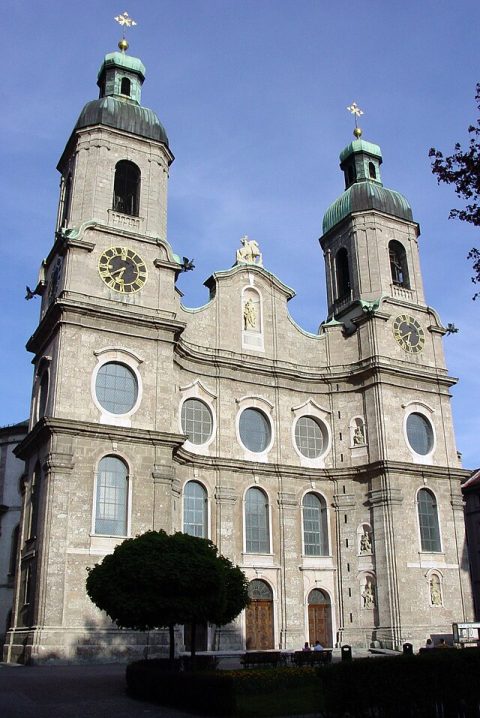
Dom zu St. Jakob (Innsbruck Cathedral)
The Cathedral of St. James is Innsbruck's principal church, a superb Baroque building completed in 1724. Its twin-towered façade dominates the Domplatz, while the ornate interior features magnificent ceiling frescoes by the Asam brothers depicting the life of St. James — among the finest Baroque fresco cycles in Tyrol. Above the high altar hangs Lucas Cranach the Elder's Mariahilf, a 16th-century painting of the Virgin venerated for centuries. Entry is free.
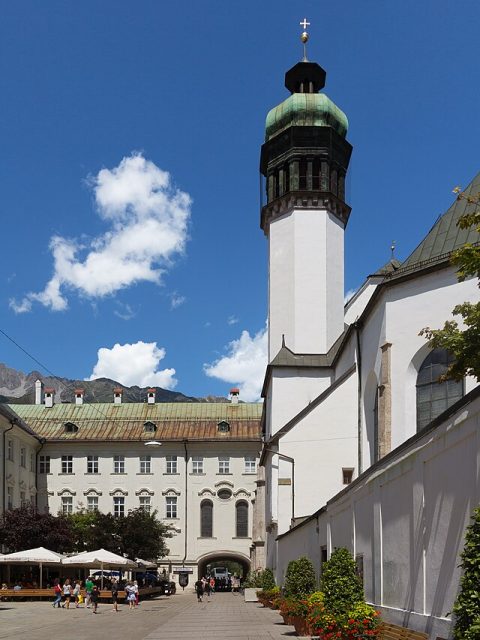
Hofkirche (Court Church)
The Hofkirche is one of the most important Renaissance churches in the German-speaking world, built 1553–1563 to house the cenotaph of Emperor Maximilian I. The empty tomb is surrounded by 28 life-sized bronze statues of his ancestors — including King Arthur and Theodoric the Great — while 24 marble reliefs illustrate scenes from his life. The adjacent Silberne Kapelle (Silver Chapel) contains the tomb of Archduke Ferdinand II and his beloved consort Philippine Welser.
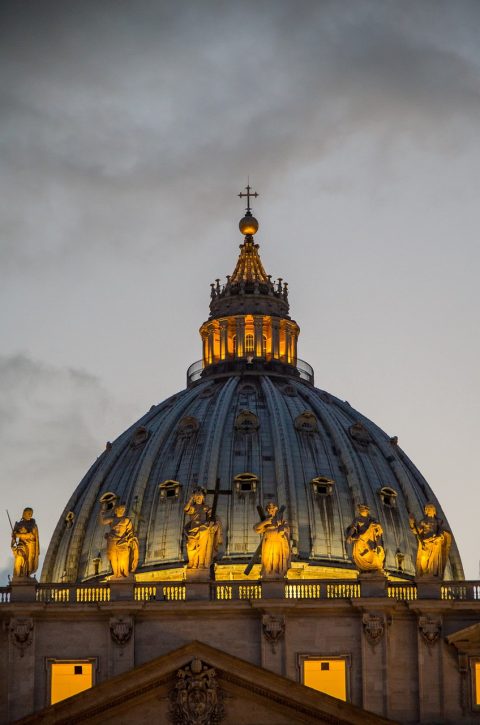
Basilica of Wilten
The Basilica of Wilten is one of the most beautiful Rococo churches in Austria, built in the 1750s. Its interior is an exuberant celebration of Rococo art: elaborate stucco work, vibrant ceiling frescoes, and an atmosphere of extraordinary lightness and colour. It is an active place of pilgrimage, housing a revered Gothic Madonna known as Our Lady under the Four Columns. The basilica is a short tram ride from the city centre and free to enter.
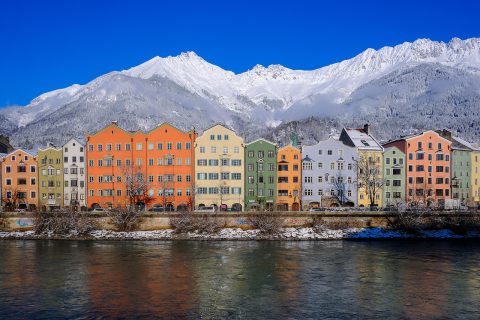
Stift Wilten (Wilten Abbey)
Wilten Abbey is a Premonstratensian monastery founded in the 12th century — one of the oldest religious communities in Tyrol. The abbey church dates from the 17th century, featuring powerful Baroque frescoes and fine choir stalls. The abbey also has a small museum. The abbey stands immediately adjacent to the Wilten Basilica, making a combined visit natural and rewarding.
Tips for Religious Sites
- The Hofkirche and the Volkskunstmuseum share a combined ticket — visit both in one trip.
- Dress modestly when entering all churches; shoulders and knees should be covered.
- The Cathedral and Hofkirche are in the Old Town and can be combined in a single walking tour.
- Masses are held regularly at all sites — check schedules to avoid arriving during services.
Innsbruck's pedestrian heart is one of the most picturesque in the Alpine world — a blend of medieval arcaded lanes, Baroque street furniture, and a grand imperial boulevard, all framed by the spectacular Nordkette mountain range as an ever-present backdrop.
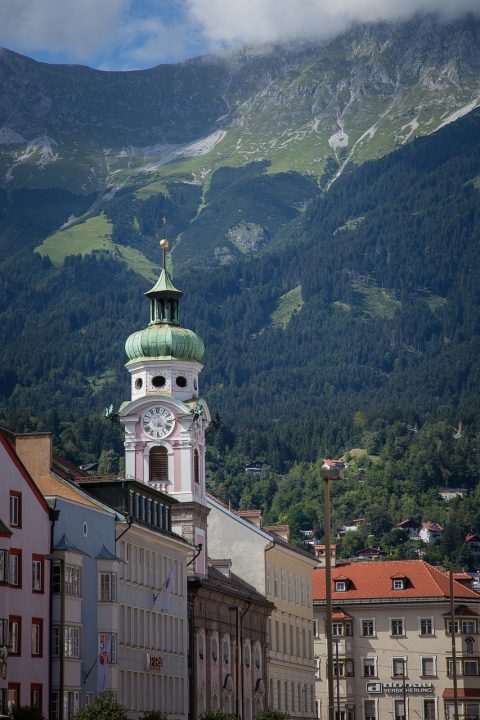
Maria Theresien Strasse
Maria Theresien Strasse is Innsbruck's grand main boulevard, stretching from the Altstadt to the Triumphpforte. Named after Empress Maria Theresa, the street is lined with elegant Baroque and Biedermeier townhouses, upscale shops, and pavement cafés. The view northward from the Annasäule column — down the boulevard toward the Nordkette — is one of the most photographed scenes in all Austria. The street is largely pedestrianised and buzzing with life at all hours of the day.
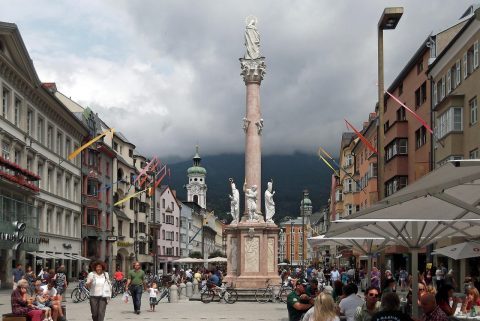
Altstadt – Herzog-Friedrich-Strasse
The heart of Innsbruck's Altstadt, Herzog-Friedrich-Strasse is a beautifully preserved medieval street running from the Inn River to the Goldenes Dachl. Both sides are lined with arcaded Gothic and Renaissance buildings — a rarity in the Alps — with ground-floor arches sheltering boutiques, cafés, and jewellery shops. Closed to traffic and perfect for a slow promenade, it is the soul of historic Innsbruck: equally enchanting under winter snow or in summer sunshine.
Domplatz & Rennweg
Domplatz sits in front of the Cathedral of St. James, serving as a lively outdoor gathering space throughout the year. The adjacent Rennweg links Domplatz to the Hofburg and Hofgarten, lined with Baroque architecture including the former Imperial residence. This corridor is the ceremonial spine of historic Innsbruck: grand, spacious, and anchored by the cathedral's twin towers at one end and the palace's ochre façade at the other. The Christmas market here in December is among the most atmospheric in Austria.
Tips for Squares & Streets
- Walk Maria Theresien Strasse at dusk for the best light on the mountains — the view is magical at golden hour.
- The arcades along Herzog-Friedrich-Strasse provide welcome shelter during rain showers.
- The Christmas markets (late November through January) transform these streets into a fairy-tale setting.
- Allow time to explore the small lanes branching off the main street — many hide cosy wine bars and local boutiques.
Beyond the historic centre, Innsbruck's distinct neighbourhoods offer authentic local colour: the village-like calm of Wilten with its abbey and basilica, the student energy of the university quarter, and the hillside drama of Hötting rising above the north bank of the Inn River.
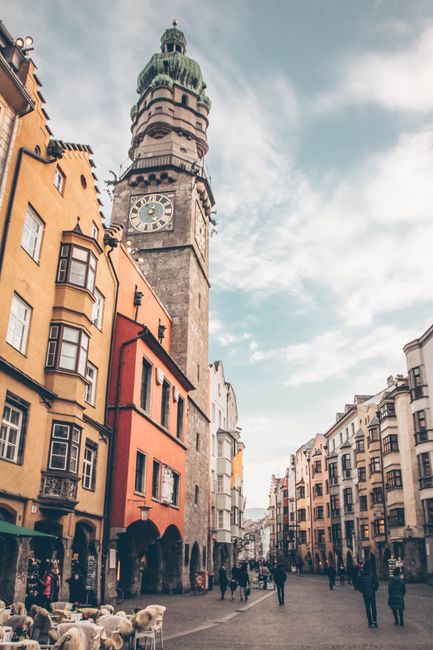
Altstadt (Old Town)
Innsbruck's Altstadt is the historic core of the city — a remarkably well-preserved ensemble of medieval, Gothic, and Baroque buildings concentrated between the Inn River and the Hofburg. Key sights including the Goldenes Dachl, Stadtturm, Cathedral, and Hofburg are all within easy walking distance. The neighbourhood's arcaded streets, colourful painted façades, and dramatic mountain backdrop create an atmosphere found nowhere else in the Alps. Both winter and summer visits offer unforgettable scenes.
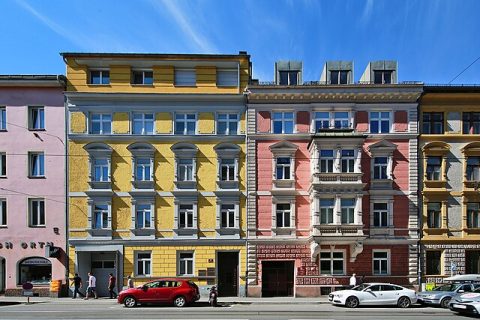
Wilten
Wilten is Innsbruck's oldest settled quarter, built on the site of the Roman garrison town of Veldidena. Today it is an atmospheric residential neighbourhood anchored by the twin landmarks of the Wilten Basilica and Wilten Abbey. The tram rumbles through quiet streets past handsome bourgeois houses, giving the area a genuine local feel far from tourist crowds. The Bergisel hill at the south end rises steeply, offering walks to the ski jump and panoramic city views above.
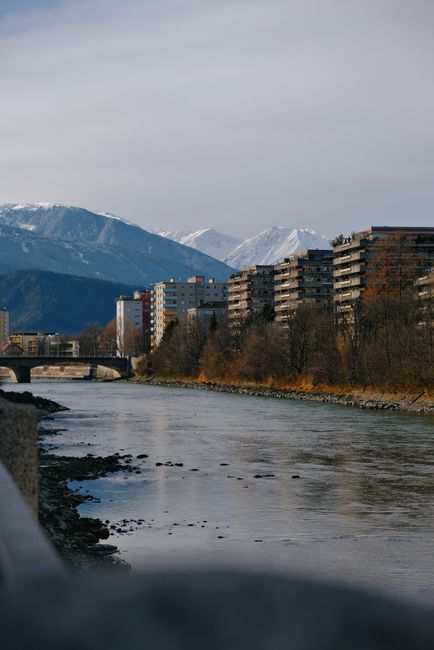
Hötting & Hungerburg
Hötting is a hillside neighbourhood on the north bank of the Inn with records dating to the 11th century. Climbing further, the Hungerburg district is reached by funicular and serves as the gateway to the Nordkette cable car network. From Hungerburg, views over the entire Inn Valley and city spread below are spectacular. The area offers a mix of villas, walking trails, and mountain restaurants — a favourite local escape from city heat in summer.
Tips for Neighborhoods & Districts
- The Altstadt is compact enough to explore entirely on foot in half a day.
- Wilten is easily reached by tram lines 1 and 3 from the city centre.
- Take the Hungerburgbahn funicular from Congress Station — the glass stations designed by Zaha Hadid are an attraction in themselves.
Innsbruck's green spaces range from formal imperial gardens to wild mountain meadows accessible within minutes of the city centre. The surrounding Alps ensure that genuine wilderness is never more than a cable car ride away, offering some of Europe's most accessible high-Alpine terrain.
Nordkette Alpine Terrain
The Nordkette mountain range rises directly above Innsbruck to 2,334 metres, offering spectacular Alpine scenery accessible year-round via the Nordkettenbahn cable car. In summer the high-altitude terrain is ideal for hiking, mountain biking, and paragliding; in winter it becomes a ski resort with runs descending nearly to the city. The area around the Seegrube and Hafelekar stations offers jaw-dropping panoramas, Alpine wildflowers, and playful marmots at close range.
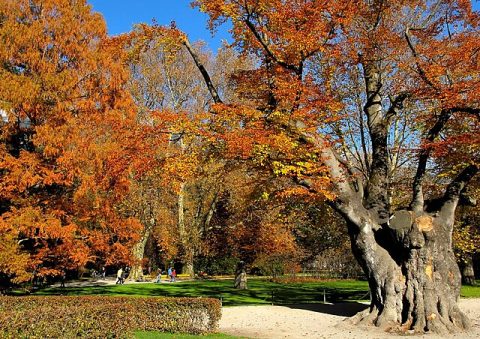
Hofgarten (Court Garden)
The Hofgarten is Innsbruck's most beloved public park, stretching from the Hofburg to Rennweg. Originally a Renaissance pleasure garden for the Habsburg court, it was redesigned in the English landscape style in the 19th century. Today it features magnificent old specimen trees, a glass pavilion used for open-air concerts, a children's playground, and a boules court popular with locals. It is a favourite lunchtime retreat for office workers and a peaceful stroll after visiting the nearby palace. Entry is free.
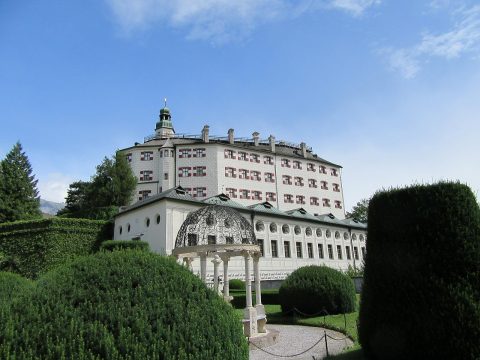
Schloss Ambras Park
The park surrounding Ambras Castle is one of Innsbruck's most pleasant green escapes: a landscaped hillside garden with shaded walks among ancient trees, ornamental ponds, and lovely views of the city below. The lower garden features a Renaissance geometric layout while the upper terraces are more naturalistic. Entry to the park is free (castle entry is separate), making it a popular Sunday outing for local families. Best visited in May when the chestnut trees along the central alley are in full flower.
Tips for Parks & Gardens
- The Hofgarten pavilion hosts free open-air concerts in summer — check the city events calendar.
- Bring sunscreen and water for Nordkette — UV exposure is significantly higher at altitude even on cloudy days.
- Marmots are commonly spotted near Hafelekar in summer; dawn and dusk are the best viewing times.
- The Nordkettenbahn is included in the Innsbruck Card.
From high-altitude skiing to crystal-encrusted art installations, Innsbruck's activity scene spans an extraordinary range. Whether you seek outdoor adventure, cultural immersion, or winter thrills, the city and its Alpine hinterland deliver world-class experiences throughout the year.
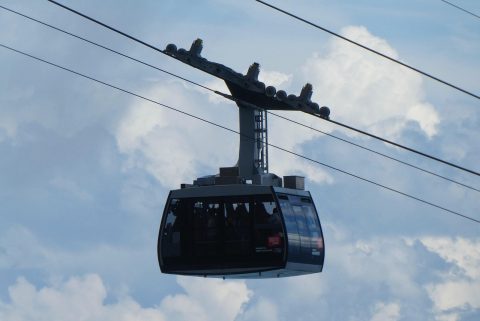
Nordkettenbahn Cable Car
The Nordkettenbahn is Innsbruck's most thrilling urban attraction: a three-stage journey by funicular and cable car from the city centre at 574 metres to the Hafelekar station at 2,256 metres (the summit is 2,334 m) in under 25 minutes. The lower Hungerburgbahn funicular stations were designed by Zaha Hadid with curvaceous organic forms. At the summit the panorama of the Inn Valley and Central Alps is breathtaking. Summer brings hiking across high-Alpine terrain; winter brings skiing with runs back to the city.
Skiing & Snowboarding in Innsbruck
Innsbruck is unique among world cities for offering genuine skiing directly from the urban core. The SKI plus CITY Pass Stubai Innsbruck covers 12 ski areas around the city and in the Stubai Valley, including the Nordkette, Axamer Lizum, Patscherkofel, Kühtai and the Stubai Glacier, plus city attractions. The city hosted Winter Olympic ski events in 1964 and 1976 at venues still in active use today. Ski buses connect the city to all resorts; equipment rental is available at every base station.
Old Town Guided Walking Tour
Expert local guides bring Innsbruck's Habsburg history alive on guided walking tours of the Altstadt (1.5–2 hours). From Maximilian I's love of tournaments at the Goldenes Dachl to the intrigue of the imperial court at the Hofburg, tours cover the Stadtturm, cathedral, arcaded medieval streets, and the city's Olympic heritage. Free tip-based tours depart daily from the Goldenes Dachl; the Innsbruck Tourist Board also runs official guided tours in English.
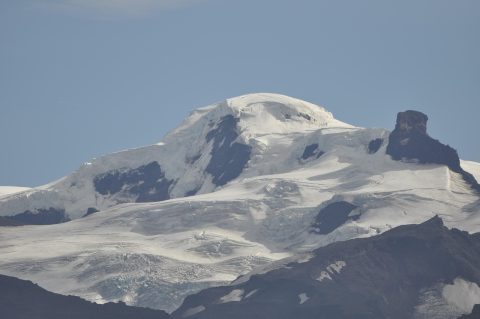
Stubaier Gletscher (Stubai Glacier)
The Stubaier Gletscher, 40 km south of Innsbruck in the Stubai Valley, is Austria's largest glacier ski area and one of the Alps' longest ski seasons (about October to May), below peaks rising to 3,333 metres. Beyond skiing, the glacier offers spectacular summer hiking, and the 360° viewing platform. Buses run from Innsbruck to the glacier.
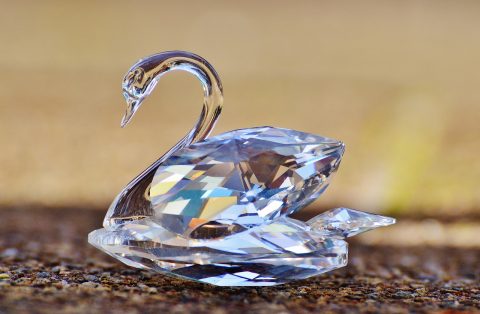
Swarovski Crystal Worlds
Swarovski Crystal Worlds in Wattens (18 km east of Innsbruck) is one of Austria's most visited attractions. The underground chambers of the Giant — a mossy water-spitting head built into a hillside — house extraordinary art installations by international artists made with Swarovski crystal. The outdoor crystal garden, Chamber of Wonder, and rotating special exhibitions make this a rewarding half-day excursion. A regular shuttle bus departs from Innsbruck Hauptbahnhof.
Tips for Tours & Activities
- Book ski lessons and equipment rental in advance during peak winter season (Christmas and February half-term).
- The Nordkettenbahn can be very busy on sunny winter weekends — arrive before 9 am to beat the queues.
- The free Stubaier Gletscher ski bus departs from Innsbruck Hauptbahnhof — check the current timetable at stubaier-gletscher.com.
- Swarovski Crystal Worlds uses timed-entry tickets — book online in advance, especially in summer.
Innsbruck is ideally positioned as a base for exploring spectacular mountain and heritage destinations across the Austrian Alps and into Italy, with most major excursions reachable within 30–90 minutes by public transport from the Hauptbahnhof.
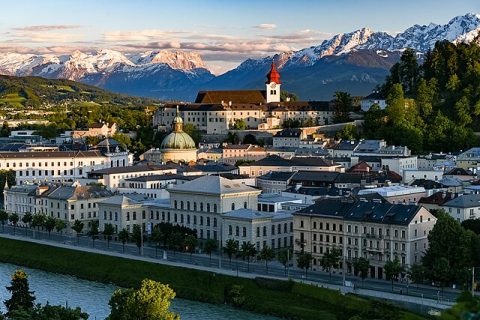
Salzburg
Salzburg, Mozart's birthplace and the filming location of The Sound of Music, is one of Austria's most beautiful cities. The UNESCO-listed Old Town clusters below the dramatic Hohensalzburg Fortress, with Baroque churches, the historic Getreidegasse, Mirabell Gardens, and world-class music venues. From Innsbruck, direct trains reach Salzburg in approximately 1 hour 50 minutes — a very manageable day trip, though an overnight stay does it fuller justice.
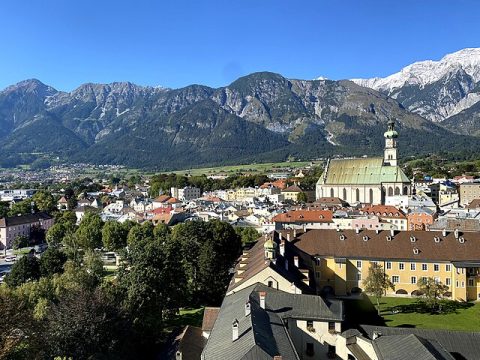
Hall in Tirol
Just 10 km east of Innsbruck, Hall in Tirol is arguably the best-preserved medieval town in Tyrol — and far less visited. Founded as a salt-mining hub, the Old Town is a labyrinth of cobbled lanes, Gothic churches, and handsome merchants' houses. The Münzerturm (Mint Tower) recalls its history as the site of Austria's first Thaler coin mint. Direct trains from Innsbruck Hauptbahnhof take just 11 minutes, making Hall the easiest possible half-day excursion.
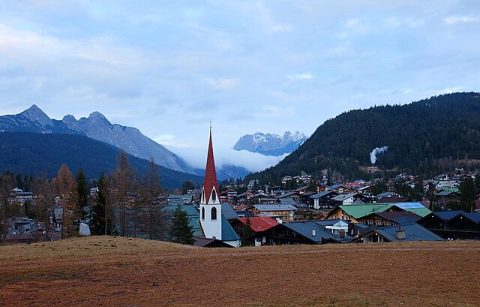
Seefeld in Tirol
Seefeld, 25 km northwest of Innsbruck at 1,200 metres altitude, is one of Austria's most elegant mountain resort villages. Famous for Nordic skiing events (it hosted the Olympic Nordic events in 1964 and 1976 and the 2019 Nordic World Ski Championships), Seefeld also offers superb alpine skiing, hiking, and a charming pedestrian village with quality restaurants and shops. The 40-minute regional train journey from Innsbruck is scenic and relaxing.
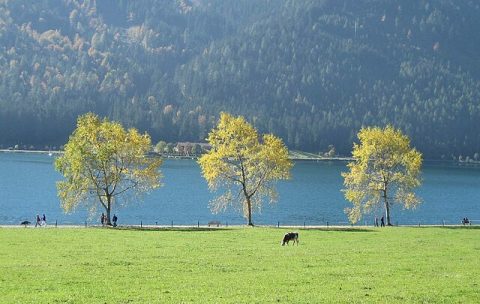
Achensee (Lake Achen)
Achensee, 40 km north of Innsbruck, is Tyrol's largest lake — a stunning fjord-like stretch of turquoise water hemmed in by steep forested mountains. In summer it is ideal for swimming, sailing, and kayaking; surrounding trails offer excellent hiking. The vintage steam-powered Achenseebahn — Europe's oldest steam-powered rack railway, running since 1889 (May to late October; no winter service) — runs from Jenbach to the lake, adding a heritage transport highlight. Jenbach is 30 minutes by train from Innsbruck.
Brenner Pass & South Tyrol
A scenic drive or train journey south from Innsbruck through the Inn Valley toward the Brenner Pass (1,374 m) crosses into Italy through some of the Alps' most dramatic scenery. The Brenner Autobahn spans the Europabrücke — at 190 metres one of Europe's highest motorway bridges. Just beyond the Austrian-Italian border, the medieval market town of Vipiteno/Sterzing in South Tyrol is a rewarding stop with a bilingual Alpine character.
Tips for Day Trips & Excursions
- Hall in Tirol is best explored on a weekday to enjoy its medieval streets without weekend crowds.
- Book Salzburg accommodations well in advance during the Salzburg Festival season (July–August).
- The Achenseebahn steam railway is seasonal (May–October) — check the timetable before visiting.
- ÖBB day passes and Sparschiene (advance) tickets offer significant savings on train day trips from Innsbruck.
Real, highly-rated Restaurants in Innsbruck, sourced from Google Places (rating above 4★).
Restaurant Oniriq
Restaurant Oniriq is a highly-rated restaurant in Innsbruck, rated 4.9★ from 335 reviews. Located at Bürgerstraße 13, 6020 Innsbruck, Austria.
Opening Hours
- Monday: Closed
- Tuesday: Closed
- Wednesday: 6:00 PM – 12:00 AM
- Thursday: 6:00 PM – 12:00 AM
- Friday: 6:00 PM – 12:00 AM
- Saturday: 6:00 PM – 12:00 AM
- Sunday: Closed
Le Murge
Le Murge is a highly-rated restaurant in Innsbruck, rated 4.8★ from 650 reviews. Located at am Wiltener Platzl, Leopoldstraße 27, 6020 Innsbruck, Austria.
Opening Hours
- Monday: 8:00 AM – 3:00 PM
- Tuesday: 8:00 AM – 10:00 PM
- Wednesday: 8:00 AM – 10:00 PM
- Thursday: 8:00 AM – 10:00 PM
- Friday: 8:00 AM – 10:00 PM
- Saturday: 8:00 AM – 10:00 PM
- Sunday: Closed
Pippilotta
Pippilotta is a highly-rated restaurant in Innsbruck, rated 4.8★ from 182 reviews. Located at Heiliggeiststraße 7-9, 6020 Innsbruck, Austria.
Opening Hours
- Monday: 8:30 AM – 6:00 PM
- Tuesday: 8:30 AM – 6:00 PM
- Wednesday: 8:30 AM – 6:00 PM
- Thursday: 8:30 AM – 9:00 PM
- Friday: 3:00 – 9:00 PM
- Saturday: 3:00 – 9:00 PM
- Sunday: 9:00 AM – 1:00 PM
Explore Innsbruck on the Map
Best Time to Visit Innsbruck
Innsbruck is a compelling year-round destination with distinctly different seasonal appeals.
| Season | Months | Highlights | Weather |
|---|---|---|---|
| Winter | December – March | World-class skiing, Christmas markets, New Year celebrations, cosy Alpine atmosphere | −5°C to 5°C; frequent mountain snow |
| Spring | April – May | Fewer crowds, wildflower blooms on Alpine meadows, Ambras Castle park at its best | 5°C to 18°C; occasional rain |
| Summer | June – September | Hiking, cycling, outdoor festivals, long daylight hours, glacier skiing at Stubai | 20°C to 28°C; afternoon thunderstorms possible |
| Autumn | October – November | Golden foliage, quieter museums, harvest markets, excellent accommodation value | 5°C to 15°C; misty mornings |
Best overall months: July–August for summer hiking and outdoor events; January–February for peak skiing; December for enchanting Christmas markets.
Getting Around Innsbruck
By Air
Innsbruck Airport (INN) is just 4 km west of the city centre, served by Austrian Airlines, Lufthansa, British Airways, easyJet, and seasonal charter carriers. Bus line F connects the airport to the Hauptbahnhof in about 20 minutes; taxis cost approximately €15–20.
By Train
Innsbruck Hauptbahnhof sits on the main Munich–Verona rail corridor with direct connections to Munich (1h 50m), Vienna (4h), Salzburg (1h 50m), Zurich (3h 30m), and Verona (3h 30m). ÖBB (oebb.at) runs frequent services; book in advance for the best fares.
Within the City
- Trams (Straßenbahn): Lines 1 and 3 cover the main east-west axis through the city centre. Modern low-floor vehicles run frequently from early morning to midnight.
- Buses: The IVB network covers all neighbourhoods including Wilten and suburban areas. Night buses run on weekends.
- Nordkettenbahn / Hungerburgbahn: Funicular plus cable car to the Nordkette mountains — included in the Innsbruck Card.
- By Bike: Nextbike city bike-sharing is available across the city; dedicated cycle lanes run along the Inn riverbanks.
- On Foot: The Altstadt and most central sights are easily walkable within 15 minutes of the Hauptbahnhof.
Tickets & Fares
A single IVB ticket costs €3.30 and a 24-hour ticket €7.30 (2026). The Innsbruck Card includes unlimited IVB travel plus cable cars — the best value option for sightseers staying 1–3 days.
✈️ Airport Transfer
Innsbruck Airport (INN) to city center:
- City Bus Line F: Runs every 15 minutes to Innsbruck city center in about 20 minutes, a regular €3.30 IVB ticket
- Taxi: Fixed rate of roughly €15 to €18 gets you to the city center in about 10 minutes
- Private Transfer Shuttle: Pre-booked door-to-door shuttle to hotels in the region takes 15 to 45 minutes depending on destination, from about €30
Shopping in Innsbruck
What to Buy
- Tyrolean handicrafts: Hand-carved wooden figures, pewterware, and painted trays — best sourced at Tiroler Heimatwerk on Meraner Strasse.
- Traditional clothing (Tracht): Dirndl dresses and Lederhosen at Giesswein or established Trachten outfitters in the Altstadt.
- Swarovski crystals: The Swarovski flagship store on Maria Theresien Strasse is the most convenient, though the Crystal Worlds in Wattens offers the full range.
- Tyrolean schnapps & spirits: Obstler, Enzian, and Williams pear brandy — widely available at delicatessens and the Markthalle.
- Local cheeses & cured meats: Tyrolean Graukäse (grey cheese), Speck ham, and mountain honey at the weekly farmers' market.
Shopping Areas
- Maria Theresien Strasse: International chains and Austrian fashion brands in the city's main shopping boulevard.
- Altstadt (Herzog-Friedrich-Strasse): Boutiques, jewellery, souvenirs, and galleries under the historic Gothic arcades.
- Markthalle (indoor market, Herzog-Siegmund-Ufer): Fresh produce, artisan cheeses, flowers, and delicatessen items — open weekdays and Saturday mornings.
- DEZ Shopping Centre: Large mall in the eastern suburbs for everyday items, electronics, and major brands.
Market Days
The weekly Bauernmarkt (farmers' market) Saturday farmers’ markets are held at Wiltener Platzl, Hötting West and St. Nikolaus; the Markthalle farmers’ market runs Monday to Saturday. — the best source of regional specialities and local producers.
Festivals & Events in Innsbruck
- Innsbruck Festival of Early Music (July–August): One of Europe's foremost festivals for Baroque and Renaissance music, held in magnificent venues including the Ambras Castle Courtyard and the Hofburg. Internationally renowned performers and period orchestras.
- In 2026, some Innsbruck Christmas markets open on 13 November; opening and closing dates vary by market: Multiple atmospheric markets across the Old Town, Maria Theresien Strasse, and Marktplatz — widely regarded as some of the most beautiful in the Alpine region.
- Bergisel Four Hills Tournament (early January): One of ski jumping's most prestigious events, drawing enormous crowds to the Bergisel Stadium as part of the famous Four Hills Tournament series.
- Almabtrieb (September–October): The traditional cattle drive from high Alpine pastures back to the valleys — a colourful folk celebration with flower-garlanded cows, cowbells, Tyrolean music, and local food.
- New Year's Eve (Silvester): Spectacular fireworks visible across the city with the illuminated Alps as a dramatic backdrop, centred around Maria Theresien Strasse.
- Summer in the City (June–August): Outdoor concerts, open-air cinema, and cultural events in parks and public spaces throughout the warm season.
5 Sample Day Itineraries in Innsbruck
Day 1 – Imperial Old Town
Morning: Begin at the Goldenes Dachl (museum opens at 10 am; closed Mondays October-April), then climb the Stadtturm for panoramic views over the rooftops. Walk to the nearby Dom zu St. Jakob to admire the magnificent Asam ceiling frescoes.
Lunch: Enjoy Tiroler Gröstl or Käsespätzle at a traditional Gasthof on Herzog-Friedrich-Strasse beneath the arcades.
Afternoon: Tour the Hofburg Imperial Palace, then stroll through the Hofgarten to the Hofkirche (with Maximilian's famous bronze statues) and the adjacent Volkskunstmuseum.
Evening: Dinner at a Tyrolean restaurant, then a promenade along the illuminated Altstadt — especially magical in winter.
Day 2 – Alpine Adventure: Nordkette
Morning: Take the Hungerburgbahn funicular from Congress Station (admire Zaha Hadid's dramatic architecture), then ride the cable car to Seegrube (1,905 m) and continue to Hafelekar (2,256 m). Hike the Panorama Trail with breathtaking 360° views.
Lunch: At the Seegrube restaurant with mountain panorama stretching across the Inn Valley.
Afternoon: Return to the city and visit the Alpenzoo at the Hungerburg funicular stop — don't miss otter feeding time.
Evening: Unwind with a spa session at a city hotel, followed by dinner at a wine bar in the Altstadt.
Day 3 – Castles, Olympics & Rococo
Morning: Take bus M to Ambras Castle — allow 2–3 hours for the palatial rooms, armour collection, Cabinet of Curiosities, and the beautiful park grounds.
Lunch: Picnic in the Ambras park, or lunch at the castle restaurant with valley views.
Afternoon: Tram to Bergisel Ski Jump — take the funicular to the top for the Olympic panorama and the architecture. Walk 10 minutes to the Wilten Basilica for its extraordinary Rococo interior.
Evening: Dinner in the Wilten neighbourhood — a more local atmosphere than the Altstadt.
Day 4 – Crystal Worlds & Hall in Tirol
Morning: Shuttle bus from the Hauptbahnhof to Swarovski Crystal Worlds in Wattens (pre-book timed entry online). Allow 2–3 hours for the underground chambers and the crystal garden.
Lunch: At the Crystal Worlds restaurant or bring a picnic to enjoy in the outdoor garden.
Afternoon: Return toward Innsbruck, stopping at Hall in Tirol (15 minutes by regional train) — explore the medieval Old Town, Mint Tower, and cobbled alleyways.
Evening: Return to Innsbruck for dinner near the Markthalle — explore local restaurants off the tourist trail.
Day 5 – Mountain Railway & Lakeside Tyrol
Morning: Train to Jenbach (30 minutes), then ride the Achenseebahn vintage steam cogwheel railway — running since 1889 (May to late October) — up to the spectacular Achensee lake.
Midday: Swim or kayak in the turquoise lake waters, or hike the shoreline trail. Lunch at a lakeside Gasthof with mountain reflections on the water.
Afternoon: Return to Innsbruck by train. Browse the Markthalle indoor market for artisan cheeses, schnapps, and Tyrolean food souvenirs.
Evening: Farewell dinner at the Seegrube mountain restaurant (cable car required) — ideally timed to catch the golden-hour Alpine panorama at sunset.
Best Photography Spots in Innsbruck
- Maria Theresien Strasse looking north: The classic Innsbruck shot — Annasäule column in the foreground, the boulevard receding into the Nordkette mountains. Best time: morning 8–10 am for soft east light; golden hour for warm mountain tones.
- Goldenes Dachl from Herzog-Friedrich-Strasse: Frame the gilded roof against the medieval arcaded façade. Best time: overcast mornings to reduce harsh reflections on the copper tiles.
- Stadtturm rooftop: 360° aerial view over Innsbruck's red-tiled rooftops with Alpine backdrop in every direction. Best time: late afternoon for warm directional light on the mountains.
- Hafelekar (2,256 m): Sweeping summit panorama from the top cable car station with the city visible far below in the green valley. Best time: early morning before afternoon clouds build up.
- Inn River promenade: Low-angle shots of the colourful Altstadt façades reflected in the fast-flowing Inn. Best time: blue hour just after sunset for mirror-like reflections.
- Bergisel Ski Jump tower: Look straight down the 70-metre ramp into the valley — a vertiginous and dramatic composition. Best time: competition days for action; clear days for the valley vista.
- Ambras Castle Spanish Hall interior: Extraordinary painted portraits lit by tall Renaissance windows in warm natural light. Best time: mid-morning when eastern sunlight enters the hall.
- Nordkette Panorama Trail: Alpine meadows, marmots, snowfields, and the valley city spread 1,700 metres below. Best time: June–September, early morning for maximum clarity.
Electricity in Innsbruck / Austria
- Voltage: 230V / 50Hz (standard European)
- Plug type: Type F (Schuko) — two round pins with grounding clips on the sides of the socket
- Adapters needed: UK visitors need a Type G to Type F adapter. US/Canada visitors require a Type A/B to Type F adapter; devices not marked 100–240V also need a voltage converter.
- USB charging: Most hotels provide USB ports at bedsides. Universal European multi-socket adapters are widely available at electronics shops in the city.
Note: Most modern electronics — phones, laptops, cameras — are dual-voltage (100–240V) and require only a plug adapter, not a voltage converter. Check the label on your device's power supply to confirm.
Food & Drink in Innsbruck
Must-Try Tyrolean Dishes
- Tiroler Gröstl: Hearty pan-fried potatoes with beef or pork and caramelised onions, topped with a fried egg — the quintessential Tyrolean comfort food.
- Käsespätzle: Soft egg noodle dumplings smothered in melted Alpine mountain cheese and topped with crispy golden fried onions.
- Tiroler Knödel: Rustic bread dumplings (plain, spinach, or speck-bacon) served in rich broth or with sauerkraut — a Tyrolean staple at every Gasthof.
- Schlutzkrapfen: Crescent-shaped pasta filled with spinach and ricotta, a South Tyrolean speciality widely available and beloved across Innsbruck.
- Tiroler Graukäse: Pungent fat-free grey cheese — an acquired taste, traditionally served on dark rye bread with vinegar and oil.
- Apfelstrudel: Flaky pastry filled with spiced apples and raisins — the classic Austrian dessert, found in every café and Konditorei.
- Tiroler Speck: Dry-cured, lightly smoked mountain ham — eaten as a starter with dark bread and freshly grated horseradish.
Where to Eat
- Traditional Gasthof: Family-run inns serving hearty Tyrolean cuisine — the most authentic dining experience in the city.
- Hüttenrestaurants: Mountain hut restaurants on the Nordkette and surrounding peaks — the setting is as memorable as the food.
- Markthalle: Innsbruck's covered indoor market on Herzog-Siegmund-Ufer — fresh produce, cheese counters, and prepared food stalls ideal for a picnic.
- Wine bars (Weinstuben): The Altstadt hides several excellent wine bars serving Austrian and northern Italian wines alongside charcuterie boards.
Local Drinks
- Obstler schnapps: Fruit brandy distilled from apples or Williams Christ pears — always offered as a warming digestif after a Tyrolean meal.
- Local beers: Stiegl, Zillertal Bier, and craft ales from Tyrolean microbreweries.
- Großer Brauner: Austria's version of a café macchiato — the standard morning coffee order in any Innsbruck café.
Tourist Passes
Innsbruck Card
The Innsbruck Card offers outstanding value for sightseers. It includes unlimited travel on all IVB public transport (trams and buses), the Nordkettenbahn and Hungerburgbahn cable cars, and free entry to 22 museums and attractions including the Hofburg, Ambras Castle, Bergisel Ski Jump, Alpenzoo, Volkskunstmuseum and Goldenes Dachl Museum. Available as 24h (€69), 48h (€79) or 72h (€89) in 2026; children aged 6-15 pay half. Buy at the tourist office, Hauptbahnhof, airport, or online.
www.innsbruck.infoSki Innsbruck All-Inclusive Pass
The SKI plus CITY Pass Stubai Innsbruck covers 12 ski areas around Innsbruck and in the Stubai Valley, and also includes city attractions. It is sold for 2 to 21 consecutive days and includes the ski buses. Offers substantial savings over purchasing individual lift tickets at each resort separately.
www.innsbruck-ski.comÖBB Sparschiene (Advance Train Tickets)
ÖBB's Sparschiene (advance purchase) fares offer up to 60% discount on standard rail fares when booked early through the ÖBB website or app. Ideal for day trips from Innsbruck to Salzburg, Vienna, Hall in Tirol, or Jenbach (for Achensee). Tickets are non-refundable but excellent value for fixed-date travel. Book at oebb.at up to 180 days in advance.
www.oebb.atMore about Innsbruck
Photo credits (29)
- Goldenes Dachl (Golden Roof): photo by Bbb, CC BY-SA 3.0, via Wikimedia Commons
- Bergisel Ski Jump: photo by Daniel Wagner at de.wikipedia, Public domain, via Wikimedia Commons
- Triumphpforte (Triumphal Arch): photo by Simon Legner (User:simon04), CC BY-SA 4.0, via Wikimedia Commons
- Annasäule (St. Anne's Column): photo by Andrew Bossi, CC BY-SA 2.5, via Wikimedia Commons
- Hofburg Imperial Palace: photo by C.Stadler/Bwag, CC BY-SA 3.0 at, via Wikimedia Commons
- Tiroler Volkskunstmuseum (Tyrolean Folk Art Museum): photo by Bede735c, CC BY-SA 3.0, via Wikimedia Commons
- Schloss Ambras (Ambras Castle): photo by The original uploader was Manu25 at French Wikipedia., CC BY-SA 2.5, via Wikimedia Commons
- Alpenzoo Innsbruck (Alpine Zoo): photo by Hafelekar, CC BY-SA 3.0, via Wikimedia Commons
- Dom zu St. Jakob (Innsbruck Cathedral): photo by Bede735c, CC BY-SA 3.0, via Wikimedia Commons
- Hofkirche (Court Church): photo by Michielverbeek, CC BY-SA 4.0, via Wikimedia Commons
- Altstadt (Old Town): photo by No machine-readable author provided. Grizurgbg assumed (based on copyright claims)., CC BY-SA 3.0, via Wikimedia Commons
- Wilten: photo by Simon Legner (User:simon04), CC BY-SA 4.0, via Wikimedia Commons
- Hofgarten (Court Garden): photo by Bbb, CC BY-SA 3.0, via Wikimedia Commons
- Hall in Tirol: photo by -wuppertaler, CC BY-SA 4.0, via Wikimedia Commons
- Seefeld in Tirol: photo by Jeff Croisé, CC BY-SA 3.0, via Wikimedia Commons
- Salzburg: photo by Jorge Franganillo, CC BY 2.0, via Wikimedia Commons
- Achensee (Lake Achen): photo by Adrian Michael, CC BY 2.5, via Wikimedia Commons
- Stadtturm (City Tower): photo by Michielverbeek, CC BY-SA 4.0, via Wikimedia Commons
- Tiroler Landesmuseum Ferdinandeum: photo by Mk pictures, CC BY-SA 3.0, via Wikimedia Commons
- Basilica of Wilten: photo by Leonhard Lenz, CC0, via Wikimedia Commons
- Stift Wilten (Wilten Abbey): photo by Smiley.toerist, CC BY-SA 4.0, via Wikimedia Commons
- Maria Theresien Strasse: photo by Wilfredor, CC0, via Wikimedia Commons
- Altstadt – Herzog-Friedrich-Strasse: photo by -wuppertaler, CC BY-SA 4.0, via Wikimedia Commons
- Hötting & Hungerburg: photo by Eweht, CC BY-SA 4.0, via Wikimedia Commons
- Schloss Ambras Park: photo by Burkhard Mücke, CC BY-SA 4.0, via Wikimedia Commons
- Nordkettenbahn Cable Car: photo by Wilfredor, CC0, via Wikimedia Commons
- Stubaier Gletscher (Stubai Glacier): photo by Basotxerri, CC BY-SA 4.0, via Wikimedia Commons
- Swarovski Crystal Worlds: photo by Costel Slincu from Iasi, Romania, CC BY 2.0, via Wikimedia Commons
- Brenner Pass & South Tyrol: photo by Vladimir Menkov, CC BY-SA 3.0, via Wikimedia Commons


.jpg)


.jpg)


.jpeg)
.jpg)


.jpg)
