Bucovina's UNESCO World Heritage painted monasteries are its defining attraction - exterior walls covered floor to roofline in vivid 15th-16th century frescoes depicting biblical scenes, designed to teach scripture to villagers who couldn't read. Each monastery has its own dominant color and iconographic program, making them distinct despite sharing the same era and purpose.
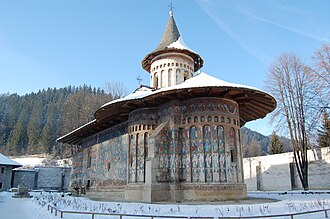
Voroneț Monastery
Known as the 'Sistine Chapel of the East', Voroneț is famous for the unique deep-blue pigment covering its western wall - dubbed 'Voroneț Blue' - against which a monumental Last Judgment fresco unfolds. Founded by Ștefan cel Mare in 1488, the monastery's frescoes remain remarkably vivid despite over 500 years of exposure. The composition includes rows of philosophers, animals, and sinners being weighed, painted with a narrative clarity meant for an illiterate congregation.
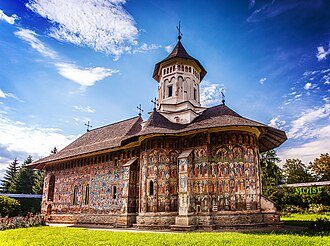
Moldovița Monastery
Surrounded by a fortified wall with defense towers, Moldovița showcases frescoes dominated by rich yellows and reds, including a detailed Siege of Constantinople scene that doubles as political commentary on the era's Ottoman threat. Founded in 1532, the monastery complex includes a small museum of icons, manuscripts, and royal gifts. Its enclosed courtyard and working convent give it a more intimate, lived-in atmosphere than some of the other painted monasteries.
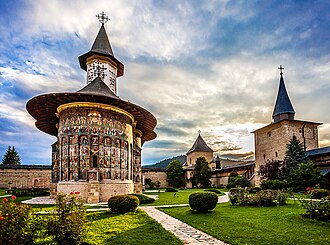
Sucevița Monastery
The largest and most heavily fortified of the painted monasteries, with massive stone walls and towers giving it the look of a citadel. Sucevița's frescoes are dominated by emerald green and include the famous 'Ladder of Virtues' scene depicting souls ascending toward heaven while demons pull them down. Built in the late 16th century, it was the last of the great painted monasteries and the closest in style to a fortress-monastery.
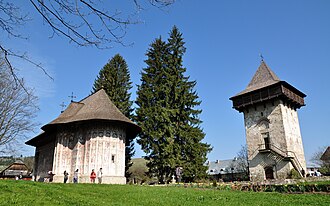
Humor Monastery
One of the oldest painted monasteries, founded in 1530, notable for its brick-red frescoes and an open porch (unusual among the group) that better protected the paintings from rain. The Siege of Constantinople fresco here is considered one of the finest, alongside vivid scenes of the Prodigal Son. A wooden defense tower, added later against Ottoman raids, still stands beside the church and can be climbed for views over the surrounding hills.
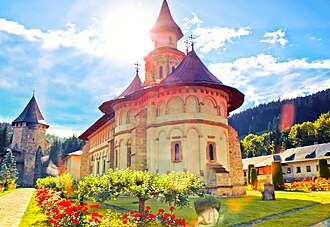
Putna Monastery
Called the 'Jerusalem of the Romanian people', Putna was founded by Ștefan cel Mare in 1466 as his necropolis, and his tomb remains here as a major pilgrimage site. Unlike the painted monasteries, Putna's exterior is unadorned, but its treasury holds an exceptional collection of medieval embroidered textiles, illuminated manuscripts, and royal gifts. The surrounding forested valley and the adjacent 'Daniil the Hermit' cave add to its spiritual atmosphere.
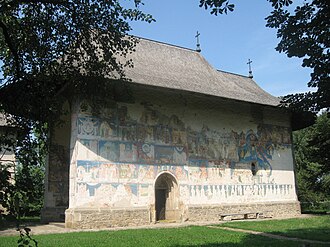
Arbore Church (Biserica Arbore)
A smaller, unfortified painted church built in 1503, distinguished by its dominant green tones and unusually detailed narrative scenes, including a rare depiction of the Creation story. Without monastery walls or a resident religious community, Arbore feels quieter and less visited than the major monasteries, letting visitors study the frescoes at close range. Weathering has faded parts of the southern facade, making the surviving color all the more striking.
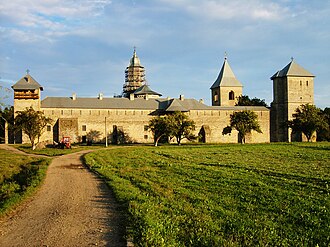
Dragomirna Monastery
Unlike its painted neighbors, Dragomirna has no exterior frescoes - its beauty comes from an extraordinarily tall, slender silhouette and intricate stone rope-carving encircling the entire church. Built in 1609, it's often called the tallest monastic church in Moldavia. The fortified complex, surrounded by thick walls and towers, also houses a valuable manuscript and icon collection, and its forested setting outside Suceava is notably peaceful.
Tips for Religious Sites
- Dress modestly - covered shoulders and knees required; wraps are often available to borrow at the gate
- Photography of frescoes is usually permitted outdoors but may require a small fee - check signage at each monastery
- Visit 3-4 monasteries per day comfortably by car; distances between them are 30-60 minutes
- Nuns/monks are in residence - keep voices low and avoid visiting during services unless attending respectfully
- Hire a local guide for at least one monastery - the iconography is dense and rewards explanation